
MindVault Supplement Facts: Panel Status, Reference Formula & How to Read Your Bottle
The seller publishes ten ingredient names and no Supplement Facts panel. This page shows what is known, reconstructs the matching formula with every estimate labeled, and gives you a worksheet for the bottle you receive.
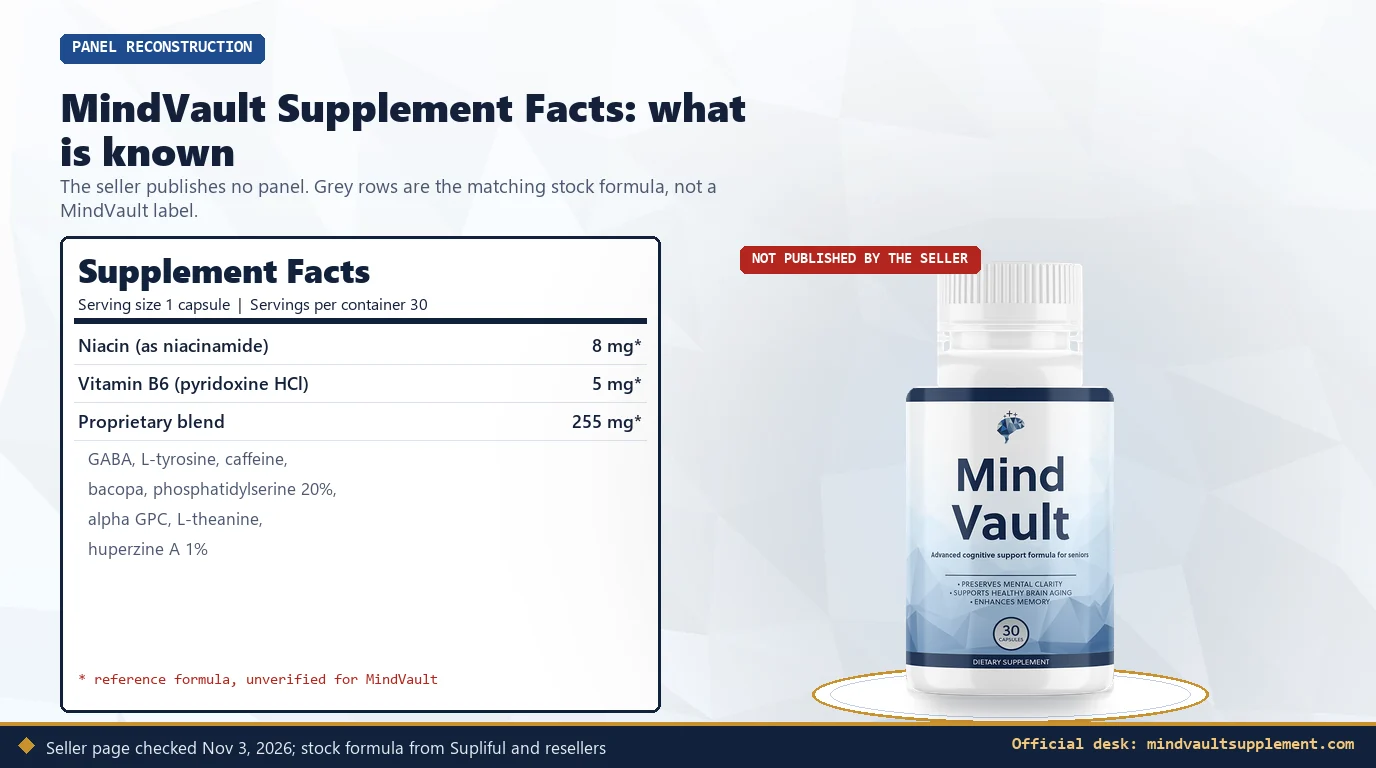
Where we looked for the MindVault panel
A Supplement Facts panel is the one part of a supplement's packaging that is regulated line by line[2]. It is the only reliable way to know what is in each serving. On November 3, 2026 we checked every place a buyer might expect to see MindVault's:
- The sales page (getmindvault.com): an ingredient card for each of the ten names, with descriptions and no amounts.
- The FAQ: "one capsule a day," 30 capsules per bottle, and the claim of "effective dosages of each ingredient (not just 'sprinkles')." No numbers.
- The References, Terms, Privacy, Contact and Returns pages: no label.
- Product images: front-of-bottle renders and pack shots only; the side panel is never shown legibly.
- The checkout: product names and prices, no label.
So the honest starting point is: MindVault's Supplement Facts panel is not published online. Everything below is either the front-label text we can read, or a reconstruction from a matching formula, labeled as such.
What the front of the bottle says
The seller's renders show a white bottle with a white screw cap, two navy bands and a faceted ice-blue label. The front text reads:
- A low-poly brain logo with three plus signs above it
- Mind Vault, in large navy letters
- "Advanced cognitive support formula for seniors"
- "Preserves mental clarity," "Supports healthy brain aging," "Enhances memory"
- A round badge: 30 capsules
- "Dietary supplement" on the lower band
The three bullet claims are structure/function statements, which is why the sales page carries the standard FDA disclaimer. Notably, the front label does not mention caffeine; buyers learn about it only from the ingredient cards on the website.
The reference panel, reconstructed
The ten ingredient names on getmindvault.com, in the same order and with the same distinctive choices (niacin as niacinamide, a 20% phosphatidylserine, huperzine at 1%), match a U.S. private-label capsule sold to brands who want their own label[1]. That stock formula is published by resellers as niacin 8 mg, vitamin B6 5 mg and a 255 mg proprietary blend, one capsule a day, 30 per bottle. We cannot confirm that MindVault is that formula, but the match is close enough to use as a working reference.
Supplement Facts
Servings per container: 30
† Daily Value not established.
| Line | Amount | % DV | Source |
|---|---|---|---|
| Niacin (as niacinamide) | 8 mg | 50% | Reference formula |
| Vitamin B6 (as pyridoxine hydrochloride) | 5 mg | 294% | Reference formula |
| 1. GABA | ≤ 255 mg | † | Order from reference; bound by 21 CFR 101.36 |
| 2. L-Tyrosine | ≤ 127 mg | † | Order from reference; bound by 21 CFR 101.36 |
| 3. Caffeine | ≤ 85 mg | † | Order from reference; bound by 21 CFR 101.36 |
| 4. Bacopa monnieri extract (whole herb) | ≤ 63 mg | † | Order from reference; bound by 21 CFR 101.36 |
| 5. Phosphatidylserine 20% (sunflower) | ≤ 51 mg | † | Order from reference; bound by 21 CFR 101.36 |
| 6. Alpha GPC powder | ≤ 42 mg | † | Order from reference; bound by 21 CFR 101.36 |
| 7. L-Theanine | ≤ 36 mg | † | Order from reference; bound by 21 CFR 101.36 |
| 8. Huperzine A 1% (Huperzia serrata, whole herb) | ≤ 31 mg (≤ ~310 mcg huperzine A) | † | Order from reference; bound by 21 CFR 101.36 |
Reading the Daily Value lines
Two lines carry Daily Values. Niacin 8 mg against a 16 mg Daily Value is 50%; adults typically get 20 mg or more from food, and the upper limit for added niacin is 35 mg[6]. Vitamin B6 5 mg against 1.7 mg is about 294%; the adult upper limit is 100 mg[7]. Neither number is a concern on its own. Both add to any multivitamin or B-complex you take.
The blend line has no Daily Value because none exists for GABA, tyrosine, caffeine, botanicals or phospholipids. That is normal. What is not normal for a product that claims "effective dosages" is the absence of individual amounts.
Why the reference formula is a credible match, and where it could differ
Private-label manufacturing is the norm for supplements sold through online funnels. A brand chooses a stock formula from a contract maker's catalog, adds its own label and markets it under a new name. Several clues point to that route here. The ten names on getmindvault.com appear in exactly the stock formula's order, including two details that are rarely combined elsewhere: niacin listed first as a vitamin, and caffeine placed between L-tyrosine and bacopa. The serving (one capsule), the count (30) and the "made in the USA" statement also match the catalog listing[1]. The seller's own description of each ingredient follows the same sequence.
Where could MindVault differ? A brand can ask the contract maker to change amounts, swap a standardization grade or add a filler, and the name list would look the same. It could also use a different maker with a similar recipe. That is why this site treats every milligram as a reference value and asks buyers to compare it with their bottle. If the brand published its panel, this section would be unnecessary.
How MindVault's disclosure compares with other memory supplements
Memory supplements fall into three disclosure tiers. The most transparent print every ingredient with its own amount and the standardization of each extract, for example "Bacopa monnieri extract (50% bacosides) 300 mg." A middle tier uses a proprietary blend but publishes the panel online, so buyers can at least see the blend total and order before paying. The least transparent publish names only, and MindVault currently sits in this tier. For an ingredient list that includes a stimulant and a cholinesterase inhibitor, that is the weakest point of the whole product, because the two numbers a pharmacist would ask for first are the two numbers nobody can see.
The descending-order rule, applied
When a supplement uses a proprietary blend, federal rules allow the maker to hide individual amounts but require two things: the total weight of the blend, and every ingredient listed "in descending order of predominance by weight"[2]. That second rule is surprisingly informative.
If eight ingredients share 255 mg and are listed heaviest first, then the first can weigh anything from about 32 mg (an even split) to nearly all of it; the second can weigh no more than half (127 mg), the third no more than a third (85 mg), the fourth a quarter (63 mg), and so on down to the eighth, which can weigh at most an eighth (31 mg). These ceilings are generous: in reality the first ingredient usually dominates and the tail ingredients are much smaller.
Applied to MindVault's reference blend, the rule shows that caffeine (third) is capped near a cup of coffee, bacopa (fourth) at about a fifth of its trial dose[10], phosphatidylserine (fifth, as a 20% extract) near 10 mg of actual PS against 300 mg studied[11], and alpha GPC (sixth) at about 3.5% of the 1,200 mg dose[12]. Huperzine A is the exception that matters: its extract is so concentrated that even a small share could deliver a dose in the range of dementia trials[9].
What the label is allowed to say
A supplement label may describe how a nutrient affects the body's structure or function ("supports healthy brain aging") if it carries the disclaimer that the FDA has not evaluated the statement and that the product is not intended to diagnose, treat, cure or prevent any disease[3]. It may not claim to treat a disease ("reverses Alzheimer's"). The FDA does not approve the label or test the product before sale[4].
MindVault's bottle stays on the right side of that line with "preserves mental clarity, supports healthy brain aging, enhances memory." The website goes further in places, describing huperzine for "seniors experiencing age-related cognitive decline" and promising that the formula "fights age-related decline," which edges toward disease language.
Lab testing: what a certificate would show
Manufacturing rules require supplement makers to set specifications for identity, purity, strength and composition, and to test against them[5]. The results usually live in a certificate of analysis (CoA) for each lot, and responsible brands publish them or send them on request. For MindVault, a useful CoA would report:
- Caffeine per capsule, measured by HPLC
- Huperzine A per capsule, measured by HPLC
- Bacoside content of the bacopa extract
- Heavy metals (lead, arsenic, cadmium, mercury) against USP limits
- Microbial counts and the absence of E. coli and Salmonella
No CoA is published, and we will not invent one. Ask the seller at [email protected] for the CoA matching the lot number printed on your bottle. If you have a reaction, report it through the FDA's MedWatch system[14][15].
Read your own bottle: a five-minute worksheet
When the parcel arrives, take five minutes with the side panel before the first capsule. Write down:
- Serving size and servings per container. Expect 1 capsule and 30.
- Every amount printed. Note niacin, B6 and the blend total. If individual amounts appear, even better.
- The blend order. Check whether caffeine sits third and huperzine last, as in the reference.
- Caffeine content. Some labels add "contains X mg caffeine." If not, assume up to 85 mg.
- Other ingredients, the capsule shell and any allergens.
- Distributor name, address and lot number. Keep a photo with your order email.
Then compare with the reference panel above. If your label differs, email us at [email protected] with a photo and we will update this page. Bring the same notes to your pharmacist; it is much easier to check interactions with the panel in hand[13].
Questions on this topic
Why doesn't MindVault publish its Supplement Facts?
The seller does not say. Some brands keep blends private to protect a recipe; others do it because the amounts look small. Either way, the panel must be on the physical bottle, so you can read it after delivery.
How much caffeine is in MindVault?
Not published. In the matching 255 mg blend, caffeine is the third ingredient, so it cannot exceed about 85 mg per capsule, roughly one mug of brewed coffee. The real amount is likely lower.
How much huperzine A is in MindVault?
Not published. The reference formula uses a 1% extract as the last blend ingredient, which caps it at about 31 mg of extract, or around 310 mcg of huperzine A. The true figure could be much lower.
What are the other ingredients in MindVault?
The seller does not list them. The matching private-label capsule uses a vegetable cellulose shell and standard flow agents; check the 'other ingredients' line on your bottle.
Is the reference formula definitely MindVault?
No. It matches all ten ingredient names and their order, the capsule count and the serving, which makes it the best available reference, but only the bottle itself or the seller can confirm it.
Sources linked from this page
Each link opens the original record. The studies tested single ingredients at their own doses, often in people with dementia; none tested a MindVault capsule.
- 1Supliful. Cognitive Support, private label capsules (catalog listing with the ten-ingredient string). supliful.com/catalog/cognitive-support-capsules
- 2Electronic Code of Federal Regulations. 21 CFR 101.36: Nutrition labeling of dietary supplements. www.ecfr.gov/current/title-21/chapter-I/subchapter-B/part-101/subpart-C/section-101.36
- 3Electronic Code of Federal Regulations. 21 CFR 101.93: Certain types of statements for dietary supplements. www.ecfr.gov/current/title-21/chapter-I/subchapter-B/part-101/subpart-F/section-101.93
- 4U.S. Food and Drug Administration. Questions and Answers on Dietary Supplements. www.fda.gov/food/information-consumers-using-dietary-supplements/questions-and-answers-dietary-supplements
- 5Electronic Code of Federal Regulations. 21 CFR Part 111: Current Good Manufacturing Practice for dietary supplements. www.ecfr.gov/current/title-21/chapter-I/subchapter-B/part-111
- 6NIH Office of Dietary Supplements. Niacin: Fact Sheet for Health Professionals. ods.od.nih.gov/factsheets/Niacin-HealthProfessional/
- 7NIH Office of Dietary Supplements. Vitamin B6: Fact Sheet for Health Professionals. ods.od.nih.gov/factsheets/VitaminB6-HealthProfessional/
- 8U.S. Food and Drug Administration. Spilling the Beans: How Much Caffeine is Too Much? www.fda.gov/consumers/consumer-updates/spilling-beans-how-much-caffeine-too-much
- 9Yang G, Wang Y, Tian J, Liu JP. Huperzine A for Alzheimer's disease: a systematic review and meta-analysis of randomized clinical trials. PLoS One. 2013;8(9):e74916. pubmed.ncbi.nlm.nih.gov/24086396/
- 10Stough C, Downey LA, Lloyd J, et al. Examining the nootropic effects of a special extract of Bacopa monniera on human cognitive functioning: 90 day double-blind placebo-controlled randomized trial. Phytother Res. 2008;22(12):1629-1634. pubmed.ncbi.nlm.nih.gov/18683852/
- 11Crook TH, Tinklenberg J, Yesavage J, Petrie W, Nunzi MG, Massari DC. Effects of phosphatidylserine in age-associated memory impairment. Neurology. 1991;41(5):644-649. pubmed.ncbi.nlm.nih.gov/2027477/
- 12De Jesus Moreno Moreno M. Cognitive improvement in mild to moderate Alzheimer's dementia after treatment with the acetylcholine precursor choline alfoscerate: a multicenter, double-blind, randomized, placebo-controlled trial. Clin Ther. 2003;25(1):178-193. pubmed.ncbi.nlm.nih.gov/12637119/
- 13National Center for Complementary and Integrative Health. Using Dietary Supplements Wisely. www.nccih.nih.gov/health/using-dietary-supplements-wisely
- 14U.S. Food and Drug Administration. MedWatch: The FDA Safety Information and Adverse Event Reporting Program. www.fda.gov/safety/medwatch-fda-safety-information-and-adverse-event-reporting-program
- 15U.S. Food and Drug Administration. How to Report a Problem with Dietary Supplements. www.fda.gov/food/dietary-supplements/how-report-problem-dietary-supplements
Run MindVault as a measured 60-day test
The order completes on the brand's own BuyGoods checkout. Before the first capsule, show the bottle to your pharmacist if you take any prescription, note three everyday memory slips you want to track, keep the confirmation email and the return form from the box, and decide by week seven whether to mail the bottles back while the window is still open.