
MindVault Reviews: A Source Audit of Testimonials, Complaints & Search Results
No star ratings here, because none can be verified. Instead: what the seller's testimonials say and do not say, what turns up in search, the complaints the formula makes predictable, and a log to write your own review.
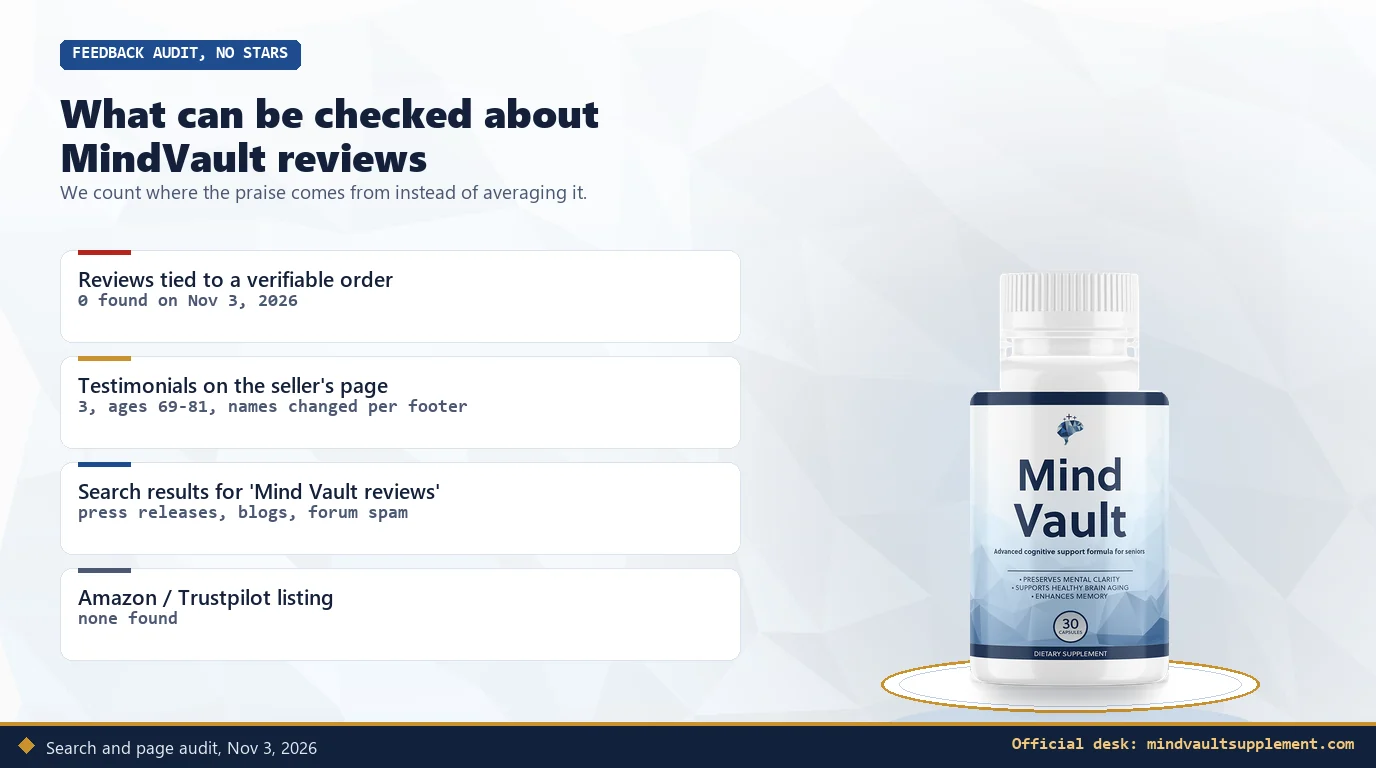
Why this page has no star rating
A star average is only as good as the reviews behind it. For MindVault, we could not find a single review tied to a verifiable purchase: no marketplace listing with buyer reviews, no review platform page, no customer photo of a bottle with an order number. Averaging what does exist, the seller's own testimonials and promotional articles, would produce a number that looks informative and is not.
So instead of stars, this page audits the sources. For each one, we ask four questions: who wrote it, whether they were paid or rewarded, whether the experience is verifiable, and whether it describes a typical result. Federal rules on endorsements ask advertisers to meet similar standards[1], and a newer rule specifically bans fake or misleading consumer reviews and testimonials[2].
The three testimonials on the seller's page
The sales page shows three quotes, each with a first name, last initial, age and the tag "Verified Purchase (6 bottles)":
- A reader aged 81 who stays sharp enough for a book club;
- A reader aged 73 who noticed better recall of names and appointments after about a month and feels more engaged with grandchildren;
- A reader aged 69 who takes it with her husband and says they are quicker at crosswords and remember events from weeks ago.
The footer then states that testimonials are "real life reactions of real customers" but that "their name has been changed for privacy," and that "individual results may vary." Renaming testimonials is not unusual, but combined with a pseudonymous doctor (also renamed, per the footer), it means nothing on the page can be independently checked. The "6 bottles" tag on all three quotes is also worth noticing: it nudges readers toward the largest pack.
What the testimonials describe, recalling names, staying engaged in conversation, finishing crosswords, are real and meaningful everyday functions. They are also the kind of change that fluctuates with sleep, mood and attention, which makes them easy to attribute to a new capsule.
The doctor who signs the guarantee
The guarantee on the sales page ends with "Sincerely, Dr. Charles Miller." A footnote then explains that Dr. Miller "is a real researcher at Mind Vault" but that "his name has been changed for privacy." That leaves a reader with an endorsement from a person who cannot be identified, whose qualifications are not stated, and whose role at a company with no published address is unclear.
Federal endorsement guides hold expert endorsers to a specific standard: the person must actually have the expertise they are presented as having, and the endorsement must be supported by an evaluation an expert in that field would make[1]. A renamed researcher cannot be checked against that standard. We do not suggest that the person does not exist; we simply give the signature no weight, and we suggest you do the same with any memory product whose expert cannot be looked up in a license database or on PubMed.
The counterfeit warning, read carefully
The sales page warns that "any products claiming to be Mind Vault on other platforms are dangerous counterfeits" that "can cause severe health problems." Counterfeit supplements do exist, and buying from the brand's own checkout is sensible for refund purposes. But on the day we checked, there was no marketplace listing to warn against. A strongly worded counterfeit warning with no named counterfeit mostly works as a reason to buy on the spot, from this page, now. It is also an odd fit with the seller's own decision not to publish the Supplement Facts panel, which is the single best tool a buyer has for spotting a fake. If a counterfeit ever does appear, the quickest check will be a side-by-side comparison of the back panel, the lot number format and the distributor line, all things a published label would make easy.
Questions worth asking the seller before you order
The support line and inbox are listed for a reason. These questions take five minutes and tell you a lot about the company behind the capsule:
- "How many milligrams of caffeine and of huperzine A are in one capsule?"
- "Can you email me the certificate of analysis for the current lot?"
- "Who manufactures MindVault, and where?"
- "Is the 60-day window counted from purchase or from delivery, and what does the 365-day line on the returns page mean?"
- "Is the $9.95 shipping refunded if I return a two-bottle order?"
Write down the answers and the date. A seller that answers clearly and quickly is easier to deal with later; one that avoids the dose questions has told you something too. Call +1 (833) 200-4172 (Monday to Friday, 5:00 a.m. to 5:00 p.m. Pacific) or write to [email protected].
What a search for MindVault reviews returns
On November 3, 2026 we searched for "MindVault reviews," "Mind Vault reviews" and "MindVault official website." The results fell into four types:
| Source type | What we found | Can it be verified? |
|---|---|---|
| Paid press releases | Newswire and GlobeNewswire articles titled as reviews, with order links | No; they are advertising |
| Review-style blogs | Blogspot, Substack and hosted pages with affiliate links and 'FDA approved' headlines | No; several make claims no supplement can make |
| Forum and file-hosting spam | Threads such as 'after 2 months my real results' on unrelated forums and cloud buckets | No; posted to rank, not by buyers |
| Marketplaces and review platforms | No Amazon, Walmart or Trustpilot listing for the capsule | Nothing to verify |
Some promotional pages use headlines like "#FDA APPROVED." No dietary supplement is FDA approved, and that phrase alone is a reason to distrust a page[3]. Others repeat the seller's ingredient descriptions word for word. None includes a photo of a received bottle's side panel, which is the one thing a real reviewer could easily add.
Complaint themes to expect
With no verifiable complaints on record, we list the issues that the formula and the policies make predictable. Plan for them before you order:
"It made me jittery or kept me awake"
Caffeine is on the ingredient list without an amount. Taken in the morning with your usual coffee reduced, most people will be fine; sensitive people may not.
"I noticed nothing"
The memory ingredients with trial support needed about 12 weeks at 300 mg a day[5][6], and they are likely present at a fraction of that. A flat result within 60 days is the most probable outcome for many buyers.
"My stomach did not like it"
Nausea, cramps and loose stools are the most common side effects of bacopa and of cholinergic compounds like huperzine A. Taking the capsule with food helps; persistent symptoms are a reason to stop.
"My pharmacist told me to stop"
Huperzine A clashes with dementia medicines and adds to drugs that slow the heart. Many buyers in the target age group take one of those.
"The refund cost me money"
Return postage is the buyer's responsibility, and the two-bottle pack's shipping fee is not promised back.
"I could not find the dose"
No Supplement Facts panel is published online. The panel is on the bottle, which you see only after paying.
What a trustworthy MindVault review would include
If you are reading reviews elsewhere, these markers separate a real buyer's account from marketing:
- A photo of the bottle's side panel, showing the Supplement Facts and the lot number
- The pack bought, the date, and what was paid, including shipping
- How long they took it, at what time of day, and with how much other caffeine
- What changed and what did not, ideally from notes rather than memory
- Any side effects and any medicines taken alongside
- Whether they asked for a refund and how it went
- A clear statement of any payment, free product or affiliate link
Reviews missing most of these, especially those that promise results for "everyone" or call the product "FDA approved," are advertising.
Write your own review: a 60-day log
The only review that will settle whether MindVault helps you is the one you write. Here is a simple template, designed to finish before the refund window closes:
- Day 0: write down three real lapses from the past week (a name, an appointment, a reason for entering a room). Score focus, sleep and mood from 1 to 10. Note your daily coffee and tea.
- Weekly: re-score the same three items and count the same kinds of lapses. Note any side effects.
- Day 45 to 50: compare. If nothing meaningful changed, request the refund and post the bottles while the window is open.
Normal forgetfulness fluctuates with sleep and stress[4], so a single good or bad week means little. A trend across several weeks means more, but it still cannot rule out the placebo effect, which is strong for subjective memory. If your lapses are getting worse rather than fluctuating, skip the supplement and see a doctor.
How memory supplements fare in reviews of the evidence
Independent evidence reviews have been consistently cautious about this category. A systematic review for the U.S. Agency for Healthcare Research and Quality found insufficient evidence that any over-the-counter supplement prevents cognitive decline or dementia[7]. Federal guidance on supplements advises telling your health care providers about everything you take and being wary of products that promise quick or dramatic results[10]. In the past, federal and state regulators have challenged memory-supplement marketers whose claims went beyond their evidence, which is one reason careful readers look for published doses and independent trials before trusting testimonials.
If you experience a side effect, report it to the FDA's MedWatch program[8]; if you believe advertising was deceptive, the FTC accepts reports online[9]. Those reports are how regulators learn about problems with products that never needed approval to reach the market.
Questions on this topic
Are MindVault reviews real?
The three testimonials on the seller's page are presented as real customers with changed names. No independent review tied to a verifiable order was found on November 3, 2026.
What is MindVault's rating?
There is no verifiable rating. We do not publish stars; our editorial score of 4.0 out of 10 rates disclosure, refund clarity, price, safety information, evidence and claim consistency, not customer satisfaction.
Is MindVault on Amazon?
We found no Amazon listing on November 3, 2026. A listing that appears later should be checked against the official bottle and should show its Supplement Facts panel.
Do MindVault reviews mention side effects?
The seller's testimonials do not. Based on the ingredients, the most likely side effects are jitteriness or poor sleep (caffeine) and stomach upset (bacopa, huperzine A).
Why do so many MindVault review pages look alike?
Many are paid press releases or affiliate pages that reuse the seller's descriptions. Look for side-panel photos, dates and disclosed payments before trusting any review.
Sources linked from this page
Each link opens the original record. The studies tested single ingredients at their own doses, often in people with dementia; none tested a MindVault capsule.
- 1Electronic Code of Federal Regulations. 16 CFR Part 255: Guides Concerning the Use of Endorsements and Testimonials in Advertising. www.ecfr.gov/current/title-16/chapter-I/subchapter-B/part-255
- 2Electronic Code of Federal Regulations. 16 CFR Part 465: Rule on the Use of Consumer Reviews and Testimonials. www.ecfr.gov/current/title-16/chapter-I/subchapter-D/part-465
- 3U.S. Food and Drug Administration. Health Fraud Scams. www.fda.gov/consumers/health-fraud-scams
- 4National Institute on Aging. Memory Problems, Forgetfulness, and Aging. www.nia.nih.gov/health/memory-loss-and-forgetfulness/memory-problems-forgetfulness-and-aging
- 5Stough C, Downey LA, Lloyd J, et al. Examining the nootropic effects of a special extract of Bacopa monniera on human cognitive functioning: 90 day double-blind placebo-controlled randomized trial. Phytother Res. 2008;22(12):1629-1634. pubmed.ncbi.nlm.nih.gov/18683852/
- 6Calabrese C, Gregory WL, Leo M, et al. Effects of a standardized Bacopa monnieri extract on cognitive performance, anxiety, and depression in the elderly: a randomized, double-blind, placebo-controlled trial. J Altern Complement Med. 2008;14(6):707-713. pubmed.ncbi.nlm.nih.gov/18611150/
- 7Butler M, Nelson VA, Davila H, et al. Over-the-counter supplement interventions to prevent cognitive decline, mild cognitive impairment, and clinical Alzheimer-type dementia: a systematic review. Ann Intern Med. 2018;168(1):52-62. pubmed.ncbi.nlm.nih.gov/29255909/
- 8U.S. Food and Drug Administration. MedWatch: The FDA Safety Information and Adverse Event Reporting Program. www.fda.gov/safety/medwatch-fda-safety-information-and-adverse-event-reporting-program
- 9Federal Trade Commission. ReportFraud.ftc.gov. reportfraud.ftc.gov/
- 10National Center for Complementary and Integrative Health. Using Dietary Supplements Wisely. www.nccih.nih.gov/health/using-dietary-supplements-wisely
Run MindVault as a measured 60-day test
The order completes on the brand's own BuyGoods checkout. Before the first capsule, show the bottle to your pharmacist if you take any prescription, note three everyday memory slips you want to track, keep the confirmation email and the return form from the box, and decide by week seven whether to mail the bottles back while the window is still open.