
MindVault Ingredients: Ten Names, Blend Order, Milligram Ceilings & Research
A monograph for each of the ten ingredients the seller names, with the largest amount each could weigh and the doses used in human studies. Written for readers over 45 who want to know what they would be swallowing.
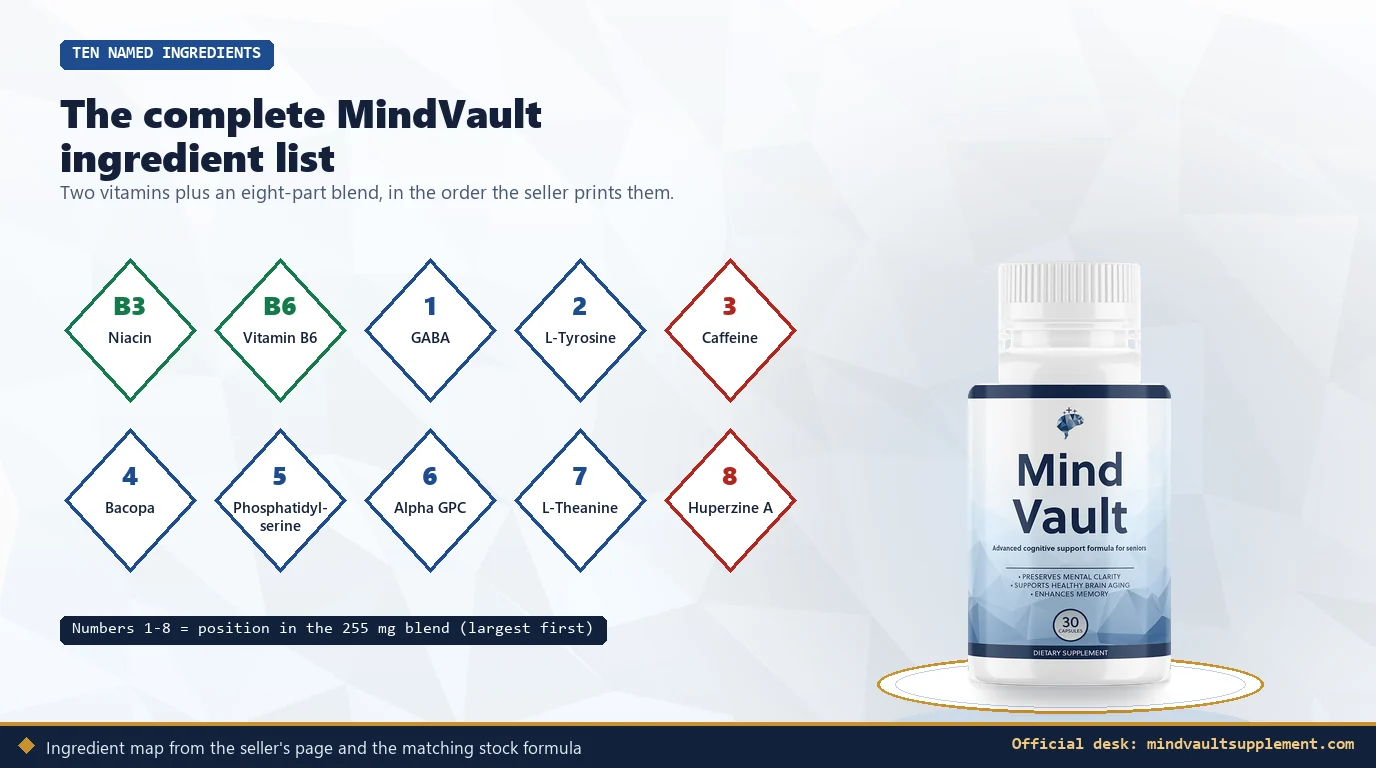
All ten MindVault ingredients in one table
The seller lists ten ingredients and prints no amounts. The table below fills the gap in the only honest way available: the two vitamins carry the figures published for the matching private-label capsule[35], and the eight blend ingredients carry the largest amount each could weigh under the federal rule that blend components appear in descending order of weight[34]. In that reference formula, the eight non-vitamin ingredients share a single 255 mg proprietary blend. Every number marked "ref." or "≤" is an estimate, unverified for MindVault, not a reading of your bottle.
| Ingredient | Where it sits | Per capsule | Human study dose | Verdict |
|---|---|---|---|---|
| Niacin (as niacinamide) | Vitamin | 8 mg (ref.) | 16 mg Daily Value for adults | Meets half the Daily Value |
| Vitamin B6 (pyridoxine HCl) | Vitamin | 5 mg (ref.) | 1.7 mg Daily Value; trials used more | About three times the Daily Value |
| GABA | Blend #1 | ≤ 255 mg | 100 to 300 mg in small stress and sleep studies | Could be in the studied range |
| L-Tyrosine | Blend #2 | ≤ 127 mg | about 7,000 to 10,000 mg (100 to 150 mg/kg) before a stressor | Under 2% of stress-study doses |
| Caffeine | Blend #3 | ≤ 85 mg | 40 to 100 mg for alertness; 400 mg is the FDA's healthy-adult ceiling | Possibly an active dose |
| Bacopa monnieri extract (whole herb) | Blend #4 | ≤ 63 mg | 300 mg of a standardized extract for 12 weeks | At most about a fifth of 300 mg |
| Phosphatidylserine 20% (sunflower) | Blend #5 | ≤ 51 mg | 300 mg of phosphatidylserine itself; this extract is 20% PS, so at most about 10 mg | About 3% of 300 mg |
| Alpha GPC powder | Blend #6 | ≤ 42 mg | 1,200 mg a day (400 mg three times) in the dementia trial | About 3.5% of 1,200 mg |
| L-Theanine | Blend #7 | ≤ 36 mg | 100 to 200 mg, often paired with 50 to 150 mg caffeine | At most about a third of 100 mg |
| Huperzine A 1% (Huperzia serrata, whole herb) | Blend #8 | ≤ 31 mg | 200 to 400 mcg of huperzine A; a 1% extract under 31 mg holds at most about 310 mcg | Possibly a drug-like dose |
Three groups emerge. The vitamins are present at ordinary daily-value amounts. The drug-like pair, caffeine and huperzine A, may be dosed at levels that act on the body. The memory and precursor ingredients, bacopa, phosphatidylserine, alpha GPC, L-tyrosine and L-theanine, are almost certainly well below the amounts used in the studies the seller relies on. The sections below take each ingredient in label order: what it is, what the seller says, what the research found and what the likely amount means.
Niacin (vitamin B3), reference 8 mg
What it is. Niacin is a B vitamin the body converts into NAD and NADP, coenzymes used in hundreds of energy reactions, including in nerve cells. It comes in two supplement forms: nicotinic acid, which causes the warm, red skin flush at higher doses, and niacinamide (nicotinamide), which does not. The reference formula uses niacinamide.
What the seller says. "Supports healthy blood flow to the brain" and helps convert food into energy. The second half is a textbook fact; the first describes a property of high-dose nicotinic acid, the flushing form, not of niacinamide at 8 mg.
What the research found. Adults need about 14 to 16 mg a day, and most Americans get more than that from meat, fish, grains and legumes[1]. In a Chicago cohort, older adults with higher niacin intake from food had a lower rate of Alzheimer's disease and slower cognitive decline[2]. That is an observational link in people eating niacin-rich diets, not a trial of a supplement.
At this dose. Eight milligrams is half the Daily Value, far below the 35 mg upper limit for added niacin. It is safe and unlikely to change anything for someone who already eats a typical diet.
Vitamin B6, reference 5 mg
What it is. Pyridoxine, in its active form pyridoxal 5'-phosphate, helps make serotonin, dopamine, GABA and norepinephrine, and it helps clear homocysteine, an amino acid linked to vascular and cognitive risk when it is high[3].
What the seller says. Essential for neurotransmitters that regulate mood and cognition. That is true of the vitamin's biology; whether extra B6 improves cognition is a different question.
What the research found. A Cochrane review found no evidence that B6 supplements improve mood or cognition in healthy older people[4]. Benefits appear mainly when someone is actually deficient, which is more common in people with kidney disease, autoimmune conditions or heavy alcohol use.
At this dose. Five milligrams is roughly three times the 1.7 mg Daily Value and well under the 100 mg adult upper limit. One caution: long-term intake from several products stacked together can cause nerve symptoms, so count B6 from any multivitamin or B-complex you already take[3].
GABA, blend position 1
What it is. Gamma-aminobutyric acid is the brain's main inhibitory messenger, the one that calms excitable circuits. It is also made commercially by fermentation and sold as a relaxation supplement.
What the seller says. A calming neurotransmitter that reduces anxiety, promotes clarity and helps restore sleep. All three are things brain GABA does; the open question is whether swallowed GABA reaches the brain.
What the research found. Most evidence suggests that GABA crosses the blood-brain barrier poorly, if at all; some of its reported effects may come through the gut-brain nerve connection instead[5]. A systematic review of oral GABA found limited evidence for stress relief and very limited evidence for sleep, from small studies at 100 to 300 mg[6]. The review on the seller's reference list concerns GABA signaling in Alzheimer's disease, not GABA pills[7].
At this dose. As the first blend ingredient, GABA is the heaviest. It must weigh at least 32 mg (the blend's average) and can weigh up to the whole 255 mg. It may be the one ingredient present in a studied amount, which makes it likely to be the bulk of the blend.
L-Tyrosine, blend position 2
What it is. An amino acid the body uses to build dopamine, norepinephrine and thyroid hormone. A chicken breast contains roughly a gram.
What the seller says. Supports dopamine and norepinephrine, which "naturally decline with age," helping sharpness, motivation and focus.
What the research found. Tyrosine's effect shows up when those messengers are being used up fast, for example during cold exposure, sleep deprivation or multitasking under pressure. The doses were large: about 100 to 150 mg per kilogram of body weight in one go[8][9]. The seller's reference about serum tyrosine in Lewy body dementia is a blood-level association in a disease group[10].
At this dose. At most 127 mg, under 2% of a stress-study dose for a 70 kg adult, and less than a single egg supplies. A real cognitive effect at that amount is not plausible; the interaction cautions (MAO inhibitors, levodopa, thyroid hormone) still apply.
Caffeine, blend position 3
What it is. The world's most used stimulant. It blocks adenosine receptors, delaying the sense of fatigue that builds up over the waking day.
What the seller says. On the ingredient card: "enhances alertness and mental energy." In the FAQ: the formula supports natural brain function "rather than providing stimulation." Both cannot be true; the ingredient card is the accurate one.
What the research found. Caffeine reliably improves vigilance, reaction time and attention, from about 40 mg upward, with the clearest effects in tired people[11]. The FDA cites 400 mg a day as an amount not generally associated with harm in healthy adults[12]. Epidemiology has linked midlife coffee drinking to lower dementia risk in some cohorts[13], but a dose-response meta-analysis of eight prospective studies found no significant association[14].
At this dose. Third in a 255 mg blend, caffeine can be at most 85 mg. If the true figure is anywhere near that, it is the ingredient you will notice. For anyone with arrhythmia, insomnia, anxiety, glaucoma or reflux, the unknown amount is a reason to ask for the lot's assay before starting.
Bacopa monnieri, blend position 4
What it is. A succulent creeping herb from wetlands in India, used for centuries in Ayurveda as a "medhya rasayana," a mind tonic. Its active saponins are called bacosides.
What the seller says. "Clinical studies show it helps seniors maintain cognitive function and recall abilities." That is a fair summary of the research, with one omission: the dose.
What the research found. In a 90-day randomized trial, 300 mg a day of a standardized extract improved spatial working memory accuracy in healthy adults[15]. In adults 65 and over, 300 mg a day for 12 weeks improved delayed word recall and reduced anxiety and depression scores[16]. A meta-analysis found improvements in attention and reaction time[17], and a systematic review concluded bacopa may improve free recall memory[18]. In diagnosed Alzheimer's disease, the evidence is too thin to conclude anything[19]. Side effects in trials were mostly nausea, stomach cramps and loose stools.
At this dose. Fourth in the blend, bacopa cannot exceed about 63 mg, and the label gives no bacoside standardization. That is at most a fifth of the studied dose, of an extract that may be weaker than the ones studied.
Phosphatidylserine 20%, blend position 5
What it is. A phospholipid concentrated in the inner layer of nerve cell membranes, where it helps with signaling and with the cell's housekeeping. Supplements used to be made from cow brain; today they come from soy or sunflower lecithin.
What the seller says. Helps maintain cell structure in the brain and supports memory and nerve cell health. The reference formula specifies a 20% sunflower extract.
What the research found. The famous positive result came from 300 mg a day of cow-brain phosphatidylserine in people with age-associated memory impairment[20]. Cow-brain products left the market over mad cow disease concerns, and soy PS at 300 to 600 mg failed to replicate the effect in a Dutch trial[21]; a Japanese trial of 100 to 300 mg soy PS found modest gains mainly in those with weaker baseline memory[22].
At this dose. At most 51 mg of a 20% extract, which is about 10 mg of phosphatidylserine. That is about 3% of the 300 mg dose and not a meaningful amount.
Alpha GPC, blend position 6
What it is. L-alpha-glycerylphosphorylcholine, a choline compound that crosses into the brain and is used to make acetylcholine. In parts of Europe and Asia it is a prescription drug called choline alfoscerate.
What the seller says. A "premium choline compound" that rapidly crosses the blood-brain barrier to raise acetylcholine.
What the research found. In 261 people with mild to moderate Alzheimer's disease, 400 mg three times a day for 180 days improved cognitive scores over placebo[23]; a 2023 meta-analysis supported benefit in adult-onset cognitive disorders at similar doses[24]. A Korean health-records study of 12 million adults over 50 linked prescribed alpha GPC with a 43% higher adjusted risk of stroke after matching, with a dose-response pattern[25]. That study cannot prove cause, but it is a signal worth knowing.
At this dose. At most 42 mg, about 3.5% of 1,200 mg. Too little to expect the trial effect, and probably too little to matter for the stroke signal either.
L-Theanine, blend position 7
What it is. An amino acid found almost only in tea leaves, often described as giving "calm alertness."
What the seller says. Increases alpha brain waves and supports focus "without the jitteriness" of cognitive enhancers.
What the research found. Paired with caffeine, about 100 mg of theanine improved accuracy and task switching[26]. Alone, 200 mg a day for four weeks reduced stress-related symptoms and improved some verbal fluency measures[27]. Animal research suggests neuroprotective effects[28], which have not been shown in people.
At this dose. At most 36 mg, roughly what a cup or two of green tea supplies, and at most a third of the paired-caffeine dose. Its jitter-softening role is plausible but small.
Huperzine A 1%, blend position 8
What it is. An alkaloid from Chinese club moss (Huperzia serrata) that reversibly blocks acetylcholinesterase. That is the mechanism of donepezil, rivastigmine and galantamine[33], and huperzine A is a licensed dementia medicine in China[29].
What the seller says. "A powerful acetylcholinesterase inhibitor" that maintains acetylcholine levels in seniors with age-related decline. The description is accurate, and it is the reason this ingredient needs the most care.
What the research found. Meta-analyses of mostly Chinese trials in Alzheimer's disease found improved cognitive scores at 200 to 400 mcg a day[29]. A U.S. multicenter trial found no benefit at 200 mcg twice a day, with a possible effect at 400 mcg twice a day in secondary analysis[30]. The Cochrane review and a 2021 overview of reviews both judged the evidence low in quality[31][32]. Reported side effects mirror the prescription drugs: nausea, vomiting, diarrhea, sweating, blurred vision, muscle twitching and a slow heart rate.
At this dose. Last in the blend, its share could be tiny or as large as about 31 mg of a 1% extract, which would mean about 310 mcg of huperzine A, inside the dementia-trial range. Without a published assay, a buyer cannot know which end applies. That uncertainty is the main reason to involve a pharmacist, especially with any heart-rate or memory medicine.
What the ingredient list leaves out
A complete label tells you more than names. Here is what MindVault's public ingredient information is missing:
- Amounts. No milligrams for any of the ten, and no blend total.
- Standardization. No bacoside percentage for bacopa; the reference formula gives 20% for phosphatidylserine and 1% for huperzine A, but the seller states neither.
- Plant parts. Federal rules require the part used for each botanical[34]; the reference formula lists "whole herb" for bacopa and huperzia.
- Other ingredients. The capsule shell (gelatin or plant cellulose), flow agents and fillers, which matter for vegetarians and people with allergies.
- Allergen and source notes. The sunflower source of phosphatidylserine is in the reference formula only; soy-derived versions are common elsewhere.
When your bottle arrives, the side panel should answer most of these. If it does not, that is useful information too.
How the ten ingredients interact with each other
Ingredient stacks are sold on the idea of synergy. Three pairings in this formula have a real basis, and one has a real downside.
- Caffeine and L-theanine are the best-supported pair; the combination is studied and the effect is short-term alertness[26].
- Alpha GPC and huperzine A push the same system from two ends: more raw material for acetylcholine and slower breakdown of it. In theory that amplifies the effect. In practice it also amplifies cholinergic side effects, and neither ingredient's amount is disclosed.
- GABA and caffeine pull in opposite directions; at these amounts the caffeine is more likely to win.
- Tyrosine and caffeine both lean on the catecholamine system, which is why people sensitive to stimulants should be cautious.
No study has tested this ten-part combination, so every synergy statement about it, including ours, is reasoning rather than evidence.
Questions on this topic
Which MindVault ingredient is most likely to have an effect?
Caffeine, if it is present near its 85 mg ceiling, followed by huperzine A, whose amount is uncertain but could fall inside the range used in dementia trials. The memory ingredients with the best evidence, bacopa and phosphatidylserine, are probably far below their studied doses.
Is MindVault vegetarian?
Unknown. The seller does not name the capsule shell. The matching private-label capsule uses a vegetable (hypromellose) shell, and its phosphatidylserine comes from sunflower, but check your bottle's 'other ingredients' line.
Does MindVault contain ginkgo, lion's mane or omega-3?
No. None of those appears on the seller's list of ten. If you already take a ginkgo, lion's mane or fish oil product, MindVault does not duplicate it, but check combined caffeine and B6 from other supplements.
Why is caffeine in a memory supplement for seniors?
Because it is the ingredient most likely to produce a felt effect quickly. That helps a product seem to work, but alertness is not the same as better memory, and older adults are often more sensitive to caffeine's effects on sleep and heart rhythm.
Is huperzine A legal in supplements?
Yes, it is sold in U.S. dietary supplements. It is also a licensed prescription medicine for dementia in China, which is a good reason to treat it with the same respect as a drug.
Sources linked from this page
Each link opens the original record. The studies tested single ingredients at their own doses, often in people with dementia; none tested a MindVault capsule.
- 1NIH Office of Dietary Supplements. Niacin: Fact Sheet for Health Professionals. ods.od.nih.gov/factsheets/Niacin-HealthProfessional/
- 2Morris MC, Evans DA, Bienias JL, et al. Dietary niacin and the risk of incident Alzheimer's disease and of cognitive decline. J Neurol Neurosurg Psychiatry. 2004;75(8):1093-1099. pubmed.ncbi.nlm.nih.gov/15258207/
- 3NIH Office of Dietary Supplements. Vitamin B6: Fact Sheet for Health Professionals. ods.od.nih.gov/factsheets/VitaminB6-HealthProfessional/
- 4Malouf R, Grimley Evans J. The effect of vitamin B6 on cognition. Cochrane Database Syst Rev. 2003;(4):CD004393. pubmed.ncbi.nlm.nih.gov/14584010/
- 5Boonstra E, de Kleijn R, Colzato LS, Alkemade A, Forstmann BU, Nieuwenhuis S. Neurotransmitters as food supplements: the effects of GABA on brain and behavior. Front Psychol. 2015;6:1520. pubmed.ncbi.nlm.nih.gov/26500584/
- 6Hepsomali P, Groeger JA, Nishihira J, Scholey A. Effects of oral gamma-aminobutyric acid (GABA) administration on stress and sleep in humans: a systematic review. Front Neurosci. 2020;14:923. pubmed.ncbi.nlm.nih.gov/33041752/
- 7Solas M, Puerta E, Ramirez MJ. Treatment options in Alzheimer´s disease: the GABA story. Curr Pharm Des. 2015;21(34):4960-4971. pubmed.ncbi.nlm.nih.gov/26365140/
- 8Jongkees BJ, Hommel B, Kühn S, Colzato LS. Effect of tyrosine supplementation on clinical and healthy populations under stress or cognitive demands: a review. J Psychiatr Res. 2015;70:50-57. pubmed.ncbi.nlm.nih.gov/26424423/
- 9Banderet LE, Lieberman HR. Treatment with tyrosine, a neurotransmitter precursor, reduces environmental stress in humans. Brain Res Bull. 1989;22(4):759-762. pubmed.ncbi.nlm.nih.gov/2736402/
- 10McCann A, Aarsland D, Ueland PM, Solvang SH, Nordrehaug JE, Giil LM. Serum tyrosine is associated with better cognition in Lewy body dementia. Brain Res. 2021;1765:147481. pubmed.ncbi.nlm.nih.gov/33865805/
- 11McLellan TM, Caldwell JA, Lieberman HR. A review of caffeine's effects on cognitive, physical and occupational performance. Neurosci Biobehav Rev. 2016;71:294-312. pubmed.ncbi.nlm.nih.gov/27612937/
- 12U.S. Food and Drug Administration. Spilling the Beans: How Much Caffeine is Too Much? www.fda.gov/consumers/consumer-updates/spilling-beans-how-much-caffeine-too-much
- 13Eskelinen MH, Kivipelto M. Caffeine as a protective factor in dementia and Alzheimer's disease. J Alzheimers Dis. 2010;20 Suppl 1:S167-S174. pubmed.ncbi.nlm.nih.gov/20182054/
- 14Larsson SC, Orsini N. Coffee consumption and risk of dementia and Alzheimer's disease: a dose-response meta-analysis of prospective studies. Nutrients. 2018;10(10):1501. pubmed.ncbi.nlm.nih.gov/30322179/
- 15Stough C, Downey LA, Lloyd J, et al. Examining the nootropic effects of a special extract of Bacopa monniera on human cognitive functioning: 90 day double-blind placebo-controlled randomized trial. Phytother Res. 2008;22(12):1629-1634. pubmed.ncbi.nlm.nih.gov/18683852/
- 16Calabrese C, Gregory WL, Leo M, et al. Effects of a standardized Bacopa monnieri extract on cognitive performance, anxiety, and depression in the elderly: a randomized, double-blind, placebo-controlled trial. J Altern Complement Med. 2008;14(6):707-713. pubmed.ncbi.nlm.nih.gov/18611150/
- 17Kongkeaw C, Dilokthornsakul P, Thanarangsarit P, Limpeanchob N, Norman Scholfield C. Meta-analysis of randomized controlled trials on cognitive effects of Bacopa monnieri extract. J Ethnopharmacol. 2014;151(1):528-535. pubmed.ncbi.nlm.nih.gov/24252493/
- 18Pase MP, Kean J, Sarris J, Neale C, Scholey AB, Stough C. The cognitive-enhancing effects of Bacopa monnieri: a systematic review of randomized, controlled human clinical trials. J Altern Complement Med. 2012;18(7):647-652. pubmed.ncbi.nlm.nih.gov/22747190/
- 19Basheer A, Agha A, Abukhalil A, et al. Use of Bacopa monnieri in the treatment of dementia due to Alzheimer disease: systematic review of randomized controlled trials. Interact J Med Res. 2022;11(2):e38542. pubmed.ncbi.nlm.nih.gov/35612544/
- 20Crook TH, Tinklenberg J, Yesavage J, Petrie W, Nunzi MG, Massari DC. Effects of phosphatidylserine in age-associated memory impairment. Neurology. 1991;41(5):644-649. pubmed.ncbi.nlm.nih.gov/2027477/
- 21Jorissen BL, Brouns F, Van Boxtel MP, et al. The influence of soy-derived phosphatidylserine on cognition in age-associated memory impairment. Nutr Neurosci. 2001;4(2):121-134. pubmed.ncbi.nlm.nih.gov/11842880/
- 22Kato-Kataoka A, Sakai M, Ebina R, et al. Soybean-derived phosphatidylserine improves memory function of the elderly Japanese subjects with memory complaints. J Clin Biochem Nutr. 2010;47(3):246-255. pubmed.ncbi.nlm.nih.gov/21103034/
- 23De Jesus Moreno Moreno M. Cognitive improvement in mild to moderate Alzheimer's dementia after treatment with the acetylcholine precursor choline alfoscerate: a multicenter, double-blind, randomized, placebo-controlled trial. Clin Ther. 2003;25(1):178-193. pubmed.ncbi.nlm.nih.gov/12637119/
- 24Sagaro GG, Traini E, Amenta F. Activity of choline alphoscerate on adult-onset cognitive dysfunctions: a systematic review and meta-analysis. J Alzheimers Dis. 2023;92(1):59-70. pubmed.ncbi.nlm.nih.gov/36683513/
- 25Lee G, Choi S, Chang J, et al. Association of L-α glycerylphosphorylcholine with subsequent stroke risk after 10 years. JAMA Netw Open. 2021;4(11):e2136008. pubmed.ncbi.nlm.nih.gov/34817582/
- 26Owen GN, Parnell H, De Bruin EA, Rycroft JA. The combined effects of L-theanine and caffeine on cognitive performance and mood. Nutr Neurosci. 2008;11(4):193-198. pubmed.ncbi.nlm.nih.gov/18681988/
- 27Hidese S, Ogawa S, Ota M, et al. Effects of L-theanine administration on stress-related symptoms and cognitive functions in healthy adults: a randomized controlled trial. Nutrients. 2019;11(10):2362. pubmed.ncbi.nlm.nih.gov/31623400/
- 28Kakuda T. Neuroprotective effects of theanine and its preventive effects on cognitive dysfunction. Pharmacol Res. 2011;64(2):162-168. doi.org/10.1016/j.phrs.2011.03.010
- 29Yang G, Wang Y, Tian J, Liu JP. Huperzine A for Alzheimer's disease: a systematic review and meta-analysis of randomized clinical trials. PLoS One. 2013;8(9):e74916. pubmed.ncbi.nlm.nih.gov/24086396/
- 30Rafii MS, Walsh S, Little JT, et al. A phase II trial of huperzine A in mild to moderate Alzheimer disease. Neurology. 2011;76(16):1389-1394. pubmed.ncbi.nlm.nih.gov/21502597/
- 31Li J, Wu HM, Zhou RL, Liu GJ, Dong BR. Huperzine A for Alzheimer's disease. Cochrane Database Syst Rev. 2008;(2):CD005592. pubmed.ncbi.nlm.nih.gov/18425924/
- 32Ghassab-Abdollahi N, Mobasseri K, Dehghani Ahmadabad A, Nadrian H, Mirghafourvand M. The effects of Huperzine A on dementia and mild cognitive impairment: an overview of systematic reviews. Phytother Res. 2021;35(9):4971-4987. pubmed.ncbi.nlm.nih.gov/33851462/
- 33MedlinePlus, U.S. National Library of Medicine. Donepezil. medlineplus.gov/druginfo/meds/a697032.html
- 34Electronic Code of Federal Regulations. 21 CFR 101.36: Nutrition labeling of dietary supplements. www.ecfr.gov/current/title-21/chapter-I/subchapter-B/part-101/subpart-C/section-101.36
- 35Supliful. Cognitive Support, private label capsules (catalog listing with the ten-ingredient string). supliful.com/catalog/cognitive-support-capsules
Run MindVault as a measured 60-day test
The order completes on the brand's own BuyGoods checkout. Before the first capsule, show the bottle to your pharmacist if you take any prescription, note three everyday memory slips you want to track, keep the confirmation email and the return form from the box, and decide by week seven whether to mail the bottles back while the window is still open.