
How MindVault Works: Brain Pathways, Ingredient Roles & What the Trials Actually Show
Memory has three stages, and each MindVault ingredient targets a different one. This page traces each mechanism, compares huperzine A with the prescription that shares its action, and checks every study on the seller's own reference list.
How memory works, in three stages
Before judging any memory supplement, it helps to know what it would have to change. Memory has three broad stages. Encoding is taking in new information, and it depends heavily on attention. Consolidation is stabilizing that information, largely during sleep, through changes in the connections between nerve cells in the hippocampus and cortex. Retrieval is pulling it back out, and it is the stage that slows most noticeably with normal aging; the name on the tip of the tongue is a retrieval problem, not a storage problem[1].
Normal aging slows processing speed and makes multitasking harder, while vocabulary and knowledge stay stable or grow. The National Institute on Aging separates this from dementia, in which memory loss disrupts daily life, gets steadily worse and affects judgment and orientation[2]. A supplement could, in principle, help encoding (through alertness), consolidation (through plasticity or sleep) or retrieval (through signaling). The question for each MindVault ingredient is which stage it targets, and whether that has been shown in people like the buyer.
The acetylcholine system and why huperzine A matters
Acetylcholine is released by nerve cells deep in the forebrain that project to the hippocampus and cortex. It sharpens attention and helps lay down new memories. In Alzheimer's disease, these cells are among the first to be lost, which is why the first generation of Alzheimer's drugs all work by preserving acetylcholine[7].
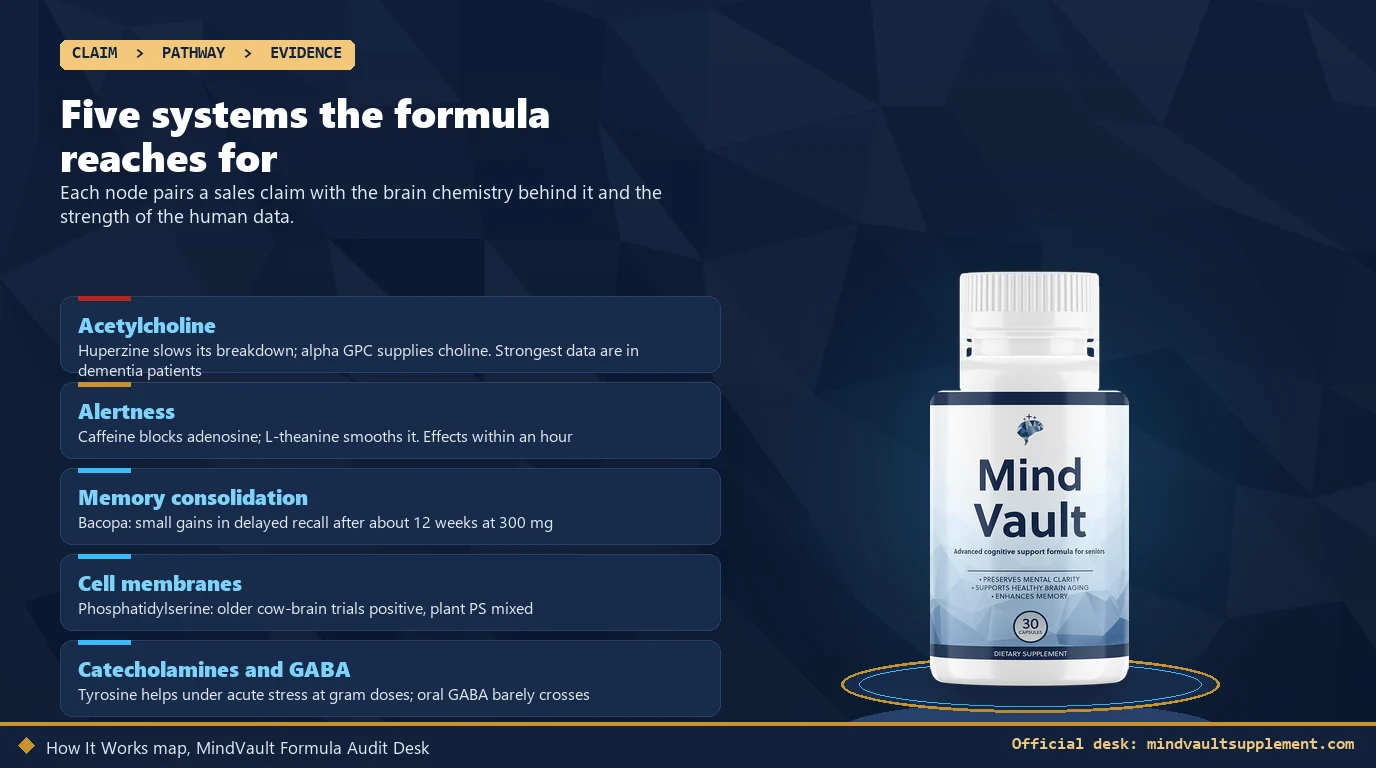
The enzyme acetylcholinesterase breaks acetylcholine down within milliseconds of its release. Blocking it lets each signal last longer. Huperzine A does exactly that, reversibly and selectively, which is why it behaves like a drug[3]. The table compares it with the prescription that shares its mechanism.
| Feature | Huperzine A (in MindVault) | Donepezil (prescription) |
|---|---|---|
| Mechanism | Reversible acetylcholinesterase inhibitor | Reversible acetylcholinesterase inhibitor |
| Regulated as | Dietary supplement (U.S.); medicine (China) | Prescription drug |
| Dose known on label | No (MindVault publishes none) | Yes, 5, 10 or 23 mg |
| Typical side effects | Nausea, diarrhea, sweating, slow pulse | Nausea, diarrhea, insomnia, slow pulse |
| Evidence in Alzheimer's | Low-quality trials, mixed results | Large trials; modest benefit |
The overlap explains the most important caution on this site: combining huperzine A with donepezil, rivastigmine or galantamine stacks two drugs with the same action[6]. The U.S. phase II trial of huperzine A in Alzheimer's found no benefit at the primary dose[4], and the Cochrane review judged the evidence insufficient to recommend it[5].
Choline supply: what alpha GPC adds
Making acetylcholine requires choline. Alpha GPC is one of the most efficient ways to deliver it to the brain, which is why it is used as a medicine in Italy and Korea. In a six-month trial in Alzheimer's disease, 1,200 mg a day improved cognitive and global scores[8]. The theory for healthy people is that more choline supports more acetylcholine production; the practical problem is that most people already get several hundred milligrams of choline a day from eggs, meat and fish, and the body regulates acetylcholine production tightly.
At no more than 42 mg, MindVault's alpha GPC is a token amount next to the trial dose. The 2021 Korean records study that linked prescribed alpha GPC with higher stroke risk concerned medical doses taken for months[9], so it says little about 42 mg, but it is one reason to be cautious with stacking choline products.
Adenosine, caffeine and L-theanine
Adenosine accumulates in the brain the longer we are awake and binds receptors that dampen arousal. Caffeine sits in those receptors without activating them, so the "tired" signal is muted. The result is better vigilance and reaction time, especially when someone is short of sleep[10]. That supports the encoding stage indirectly, because attention gates what gets remembered.
L-theanine appears to increase alpha-wave activity and to reduce the edgy side of caffeine. Three controlled studies of the pair found better accuracy or task switching, though in one the caffeine alone explained most of the effect[11][12][13]. The doses in those studies were 50 to 150 mg caffeine with 100 to 250 mg theanine. MindVault's ceilings are 85 mg and 36 mg.
This is the most predictable part of the formula: if you feel more alert within an hour of the capsule, caffeine is the likely reason. It is also the part that conflicts with the seller's FAQ, which says the product works "rather than providing stimulation."
Bacopa and phosphatidylserine: slower, structural effects
Bacopa's bacosides are thought to support the growth of dendrites, the branches through which nerve cells connect, and to act as antioxidants and modulators of acetylcholine and serotonin[16]. Those mechanisms come mainly from animal studies, but the human trials are consistent with a slow, structural effect: benefits on delayed recall appeared after about 12 weeks of 300 mg a day, not in the first weeks[14][15].
Phosphatidylserine supports membrane fluidity and signaling. Its human evidence is split by source: positive with 300 mg of the old cow-brain product[17], inconsistent with soy at similar doses[18][29]. MindVault's reference formula uses a sunflower extract that is 20% PS, so the actual phosphatidylserine is probably around 10 mg or less.
Both ingredients therefore point to the same conclusion: if they help, they help slowly and at doses this capsule cannot hold. A two-month trial, which is what the refund window allows, is short for either.
Tyrosine and GABA: precursors and the barrier problem
Tyrosine is converted into dopamine and norepinephrine. When those messengers are being used up quickly, as under cold, noise or sleep loss, extra tyrosine can protect working memory; when they are not, adding tyrosine does little[19]. The effective amounts are in grams.
GABA is the brain's brake. Its levels and signaling change with aging and in Alzheimer's disease[21][22], which is the reason it appears on memory supplement labels. But the blood-brain barrier largely excludes GABA taken by mouth[20], so a GABA capsule is not the same as more GABA in the brain. These two ingredients have the weakest link between their mechanism and a measurable memory effect.
The seller's three claims, mapped to mechanisms
| Seller's claim | Ingredients behind it | Mechanism | Human evidence at plausible doses |
|---|---|---|---|
| Memory support | Bacopa, phosphatidylserine, huperzine A, alpha GPC | Plasticity, membranes, acetylcholine | Weak: memory ingredients diluted; huperzine data in dementia only |
| Mental clarity | Caffeine, L-theanine, niacin | Adenosine block, alpha waves, metabolism | Moderate for short-term alertness (caffeine) |
| Neuroprotection | Bacopa, L-theanine, GABA | Antioxidant and anti-excitotoxic effects | Lab and animal data only |
The pattern is familiar from many memory products: the claim most likely to be noticed (clarity) rests on caffeine, while the claims buyers care most about (memory, protection from decline) rest on ingredients that are either diluted or studied only in disease. A large review of over-the-counter supplements reached a similar conclusion about the category as a whole[35].
Every study on the seller's References page, checked
The seller's site links 16 records under "References." We looked each one up on PubMed or, for two ScienceDirect links, through Crossref. Here is what each one is.
| Link ID | What it is | Study type | Gap to MindVault |
|---|---|---|---|
| 26365140 | GABA treatment options in Alzheimer's (review) | Disease mechanisms | No human GABA-pill data |
| 33865805 | Serum tyrosine and cognition in Lewy body dementia | Observational, disease group | Blood levels, not supplements |
| 20182054 | Caffeine as a protective factor in dementia | Epidemiology review | Coffee drinkers, not capsules |
| PMC6669844 | Bacopa mechanisms in Alzheimer's (review) | Mostly preclinical | Lab and animal data |
| 1609044 | Phosphatidylserine in Alzheimer's (1992) | Small trial, disease group | Cow-brain PS, 300 mg |
| 12637119 | Alpha GPC in Alzheimer's (2003) | Randomized trial, disease group | 1,200 mg a day |
| S1043661811000879 | Theanine neuroprotection (review) | Mostly animal | No memory trial in people |
| 33851462 | Huperzine A overview of reviews | Evidence synthesis | Low-quality evidence, dementia |
| S108495212100015X | GABAergic dysfunction in aging and Alzheimer's | Mechanism review | No supplement data |
| 301148 | Amino acid precursors in dementia (1977) | Early clinical study | Disease group, 1970s methods |
| PMC6213481 | Coffee and dementia risk (meta-analysis) | Prospective cohorts | No significant association found |
| 35612544 | Bacopa in Alzheimer's (systematic review) | Evidence synthesis | Too few trials to conclude |
| PMC2966935 | Soy PS in elderly with memory complaints | Randomized trial | 100 to 300 mg PS |
| PMC10041421 | Choline alfoscerate meta-analysis | Evidence synthesis | Disease groups, drug doses |
| PMC4210905 | Green tea consumption in the elderly | Pilot study | Green tea is not an ingredient |
| 21833673 | Huperzine A in vascular dementia | Small trial, disease group | Drug-level huperzine |
Six of the sixteen enrolled people with Alzheimer's or another dementia[25][8][26][27][28][33]. Three are observational[23][24][31], and the coffee meta-analysis among them found no significant link between coffee and dementia. Four are mechanism or animal reviews[22][16][34][21]. Of the two in healthier older adults, one tested phosphatidylserine at 100 to 300 mg[29] and the other tested green tea[32], which is not in the capsule. The remaining choline alfoscerate meta-analysis pooled disease groups at drug doses[30]. None tested MindVault.
What moves memory more than any capsule
For perspective: the Lancet Commission estimates that around 40% of dementia cases worldwide are linked to 12 modifiable risk factors, including hearing loss, high blood pressure, physical inactivity, smoking, depression, diabetes, social isolation, excessive alcohol and air pollution[36]. Sleep, which consolidates memory every night, is another lever with stronger everyday effects than any of the ingredients above. Treating hearing loss, controlling blood pressure and walking most days will not appear on a label, but each has better evidence for long-term cognitive health than this formula.
Questions on this topic
Does MindVault work like Aricept?
Partly, in mechanism only. Its huperzine A blocks the same enzyme as Aricept (donepezil), but at an undisclosed dose and without the large trials behind donepezil. That shared mechanism is also why the two should not be combined without a doctor.
How fast does MindVault work?
Any quick effect, within an hour, is most likely the caffeine. The memory ingredients that have trial support, bacopa and phosphatidylserine, needed about 12 weeks at 300 mg a day to show modest changes.
Can MindVault prevent dementia?
No supplement has been shown to prevent dementia, and MindVault has not been tested at all. Controlling blood pressure, treating hearing loss, staying active and not smoking have far stronger evidence.
Why does the seller cite Alzheimer's studies?
Because those are where the strongest ingredient data exist, at medical doses. They show what the compounds can do in a disease setting, not what a 255 mg blend does for a healthy adult.
Is there a study on MindVault itself?
No. None of the 16 references on the seller's page, and no record we could find on PubMed or ClinicalTrials.gov, tests the finished capsule.
Sources linked from this page
Each link opens the original record. The studies tested single ingredients at their own doses, often in people with dementia; none tested a MindVault capsule.
- 1National Institute on Aging. Memory Problems, Forgetfulness, and Aging. www.nia.nih.gov/health/memory-loss-and-forgetfulness/memory-problems-forgetfulness-and-aging
- 2National Institute on Aging. Cognitive Health and Older Adults. www.nia.nih.gov/health/brain-health/cognitive-health-and-older-adults
- 3Yang G, Wang Y, Tian J, Liu JP. Huperzine A for Alzheimer's disease: a systematic review and meta-analysis of randomized clinical trials. PLoS One. 2013;8(9):e74916. pubmed.ncbi.nlm.nih.gov/24086396/
- 4Rafii MS, Walsh S, Little JT, et al. A phase II trial of huperzine A in mild to moderate Alzheimer disease. Neurology. 2011;76(16):1389-1394. pubmed.ncbi.nlm.nih.gov/21502597/
- 5Li J, Wu HM, Zhou RL, Liu GJ, Dong BR. Huperzine A for Alzheimer's disease. Cochrane Database Syst Rev. 2008;(2):CD005592. pubmed.ncbi.nlm.nih.gov/18425924/
- 6MedlinePlus, U.S. National Library of Medicine. Donepezil. medlineplus.gov/druginfo/meds/a697032.html
- 7National Institute on Aging. How Is Alzheimer's Disease Treated? www.nia.nih.gov/health/alzheimers-treatment/how-alzheimers-disease-treated
- 8De Jesus Moreno Moreno M. Cognitive improvement in mild to moderate Alzheimer's dementia after treatment with the acetylcholine precursor choline alfoscerate: a multicenter, double-blind, randomized, placebo-controlled trial. Clin Ther. 2003;25(1):178-193. pubmed.ncbi.nlm.nih.gov/12637119/
- 9Lee G, Choi S, Chang J, et al. Association of L-α glycerylphosphorylcholine with subsequent stroke risk after 10 years. JAMA Netw Open. 2021;4(11):e2136008. pubmed.ncbi.nlm.nih.gov/34817582/
- 10McLellan TM, Caldwell JA, Lieberman HR. A review of caffeine's effects on cognitive, physical and occupational performance. Neurosci Biobehav Rev. 2016;71:294-312. pubmed.ncbi.nlm.nih.gov/27612937/
- 11Owen GN, Parnell H, De Bruin EA, Rycroft JA. The combined effects of L-theanine and caffeine on cognitive performance and mood. Nutr Neurosci. 2008;11(4):193-198. pubmed.ncbi.nlm.nih.gov/18681988/
- 12Haskell CF, Kennedy DO, Milne AL, Wesnes KA, Scholey AB. The effects of L-theanine, caffeine and their combination on cognition and mood. Biol Psychol. 2008;77(2):113-122. pubmed.ncbi.nlm.nih.gov/18006208/
- 13Giesbrecht T, Rycroft JA, Rowson MJ, De Bruin EA. The combination of L-theanine and caffeine improves cognitive performance and increases subjective alertness. Nutr Neurosci. 2010;13(6):283-290. pubmed.ncbi.nlm.nih.gov/21040626/
- 14Stough C, Downey LA, Lloyd J, et al. Examining the nootropic effects of a special extract of Bacopa monniera on human cognitive functioning: 90 day double-blind placebo-controlled randomized trial. Phytother Res. 2008;22(12):1629-1634. pubmed.ncbi.nlm.nih.gov/18683852/
- 15Calabrese C, Gregory WL, Leo M, et al. Effects of a standardized Bacopa monnieri extract on cognitive performance, anxiety, and depression in the elderly: a randomized, double-blind, placebo-controlled trial. J Altern Complement Med. 2008;14(6):707-713. pubmed.ncbi.nlm.nih.gov/18611150/
- 16Abdul Manap AS, Vijayabalan S, Madhavan P, et al. Bacopa monnieri, a neuroprotective lead in Alzheimer disease: a review on its properties, mechanisms of action, and preclinical and clinical studies. Drug Target Insights. 2019;13:1177392819866412. pubmed.ncbi.nlm.nih.gov/31391778/
- 17Crook TH, Tinklenberg J, Yesavage J, Petrie W, Nunzi MG, Massari DC. Effects of phosphatidylserine in age-associated memory impairment. Neurology. 1991;41(5):644-649. pubmed.ncbi.nlm.nih.gov/2027477/
- 18Jorissen BL, Brouns F, Van Boxtel MP, et al. The influence of soy-derived phosphatidylserine on cognition in age-associated memory impairment. Nutr Neurosci. 2001;4(2):121-134. pubmed.ncbi.nlm.nih.gov/11842880/
- 19Jongkees BJ, Hommel B, Kühn S, Colzato LS. Effect of tyrosine supplementation on clinical and healthy populations under stress or cognitive demands: a review. J Psychiatr Res. 2015;70:50-57. pubmed.ncbi.nlm.nih.gov/26424423/
- 20Boonstra E, de Kleijn R, Colzato LS, Alkemade A, Forstmann BU, Nieuwenhuis S. Neurotransmitters as food supplements: the effects of GABA on brain and behavior. Front Psychol. 2015;6:1520. pubmed.ncbi.nlm.nih.gov/26500584/
- 21Jiménez-Balado J, Eich TS. GABAergic dysfunction, neural network hyperactivity and memory impairments in human aging and Alzheimer's disease. Semin Cell Dev Biol. 2021;116:146-159. doi.org/10.1016/j.semcdb.2021.01.005
- 22Solas M, Puerta E, Ramirez MJ. Treatment options in Alzheimer´s disease: the GABA story. Curr Pharm Des. 2015;21(34):4960-4971. pubmed.ncbi.nlm.nih.gov/26365140/
- 23McCann A, Aarsland D, Ueland PM, Solvang SH, Nordrehaug JE, Giil LM. Serum tyrosine is associated with better cognition in Lewy body dementia. Brain Res. 2021;1765:147481. pubmed.ncbi.nlm.nih.gov/33865805/
- 24Eskelinen MH, Kivipelto M. Caffeine as a protective factor in dementia and Alzheimer's disease. J Alzheimers Dis. 2010;20 Suppl 1:S167-S174. pubmed.ncbi.nlm.nih.gov/20182054/
- 25Crook T, Petrie W, Wells C, Massari DC. Effects of phosphatidylserine in Alzheimer's disease. Psychopharmacol Bull. 1992;28(1):61-66. pubmed.ncbi.nlm.nih.gov/1609044/
- 26Ghassab-Abdollahi N, Mobasseri K, Dehghani Ahmadabad A, Nadrian H, Mirghafourvand M. The effects of Huperzine A on dementia and mild cognitive impairment: an overview of systematic reviews. Phytother Res. 2021;35(9):4971-4987. pubmed.ncbi.nlm.nih.gov/33851462/
- 27Meyer JS, Welch KM, Deshmukh VD, et al. Neurotransmitter precursor amino acids in the treatment of multi-infarct dementia and Alzheimer's disease. J Am Geriatr Soc. 1977;25(7):289-298. pubmed.ncbi.nlm.nih.gov/301148/
- 28Basheer A, Agha A, Abukhalil A, et al. Use of Bacopa monnieri in the treatment of dementia due to Alzheimer disease: systematic review of randomized controlled trials. Interact J Med Res. 2022;11(2):e38542. pubmed.ncbi.nlm.nih.gov/35612544/
- 29Kato-Kataoka A, Sakai M, Ebina R, et al. Soybean-derived phosphatidylserine improves memory function of the elderly Japanese subjects with memory complaints. J Clin Biochem Nutr. 2010;47(3):246-255. pubmed.ncbi.nlm.nih.gov/21103034/
- 30Sagaro GG, Traini E, Amenta F. Activity of choline alphoscerate on adult-onset cognitive dysfunctions: a systematic review and meta-analysis. J Alzheimers Dis. 2023;92(1):59-70. pubmed.ncbi.nlm.nih.gov/36683513/
- 31Larsson SC, Orsini N. Coffee consumption and risk of dementia and Alzheimer's disease: a dose-response meta-analysis of prospective studies. Nutrients. 2018;10(10):1501. pubmed.ncbi.nlm.nih.gov/30322179/
- 32Ide K, Yamada H, Takuma N, et al. Green tea consumption affects cognitive dysfunction in the elderly: a pilot study. Nutrients. 2014;6(10):4032-4042. pubmed.ncbi.nlm.nih.gov/25268837/
- 33Xu ZQ, Liang XM, Juan-Wu, et al. Treatment with Huperzine A improves cognition in vascular dementia patients. Cell Biochem Biophys. 2012;62(1):55-58. pubmed.ncbi.nlm.nih.gov/21833673/
- 34Kakuda T. Neuroprotective effects of theanine and its preventive effects on cognitive dysfunction. Pharmacol Res. 2011;64(2):162-168. doi.org/10.1016/j.phrs.2011.03.010
- 35Butler M, Nelson VA, Davila H, et al. Over-the-counter supplement interventions to prevent cognitive decline, mild cognitive impairment, and clinical Alzheimer-type dementia: a systematic review. Ann Intern Med. 2018;168(1):52-62. pubmed.ncbi.nlm.nih.gov/29255909/
- 36Livingston G, Huntley J, Sommerlad A, et al. Dementia prevention, intervention, and care: 2020 report of the Lancet Commission. Lancet. 2020;396(10248):413-446. pubmed.ncbi.nlm.nih.gov/32738937/
Run MindVault as a measured 60-day test
The order completes on the brand's own BuyGoods checkout. Before the first capsule, show the bottle to your pharmacist if you take any prescription, note three everyday memory slips you want to track, keep the confirmation email and the return form from the box, and decide by week seven whether to mail the bottles back while the window is still open.